
Advanced Chute Deployment System Options
Explore our specialized product range designed for flawless integration into residential complexes, manufacturing facilities, and industrial heavy machinery.
Quick Navigation — Select Configuration
1. Single Entry Escape Chute
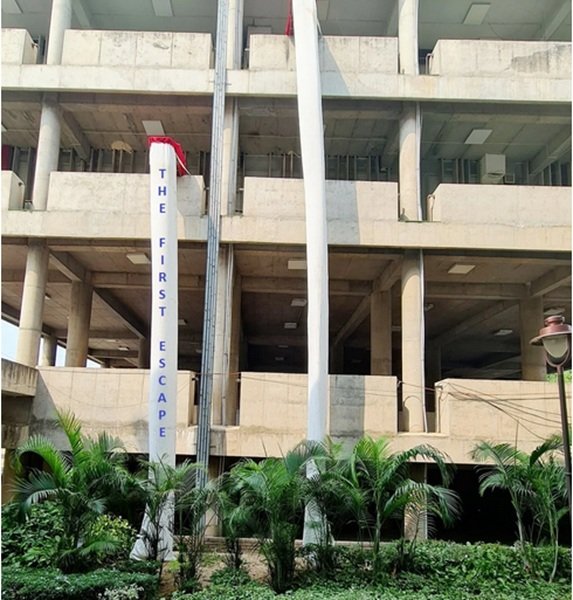
Designed as a highly dependable secondary exit channel for offices, low-rise structures, apartments, and residential buildings where an internal structural concrete shaft or duct is completely unavailable. This stationary configuration easily retrofits onto external windows, balconies, terraces, or refuge floors, providing independent rapid dropdown safety. Built with a specialized double-layer system, the outer envelope shields evacuees from ambient external flames, radiant heat, and smoke, while the middle layer provides a precise speed-restraining friction effect and safely carries the total system weight across lengths up to 200 meters. It is highly effective for the safe and smooth transport of children, elderly citizens, or physically challenged individuals during intense building emergencies.
- ✓ Application Matrix: Ideal for home fire escape chute set-ups, apartments, hotels, malls, ships, cranes, and wind turbines.
- ✓ Operational Procedure: Open the entrance cabinet -> Deploy fabric envelope block out of windows -> Step inside -> Glide down with uniform friction.
| Structural Parameters | 2F | 3F | 4F | 5F | 6F | 7F | 8F | 9F | 10F | 11F | 12F | 13F | 14F | 15F | 16F | 17F | 18F | 19F | 20F |
|---|---|---|---|---|---|---|---|---|---|---|---|---|---|---|---|---|---|---|---|
| Floor Level | 2F | 3F | 4F | 5F | 6F | 7F | 8F | 9F | 10F | 11F | 12F | 13F | 14F | 15F | 16F | 17F | 18F | 19F | 20F |
| Size (Meter) | 6M | 9M | 12M | 15M | 18M | 21M | 24M | 27M | 30M | 33M | 36M | 39M | 42M | 45M | 48M | 51M | 54M | 57M | 60M |
| Fire Escape Chute Speed | 2s | 2s | 3s | 4s | 5s | 6s | 6s | 7s | 7s | 8s | 8s | 9s | 9s | 10s | 10s | 11s | 11s | 12s | 12s |
2. Multi Entry Escape Chute
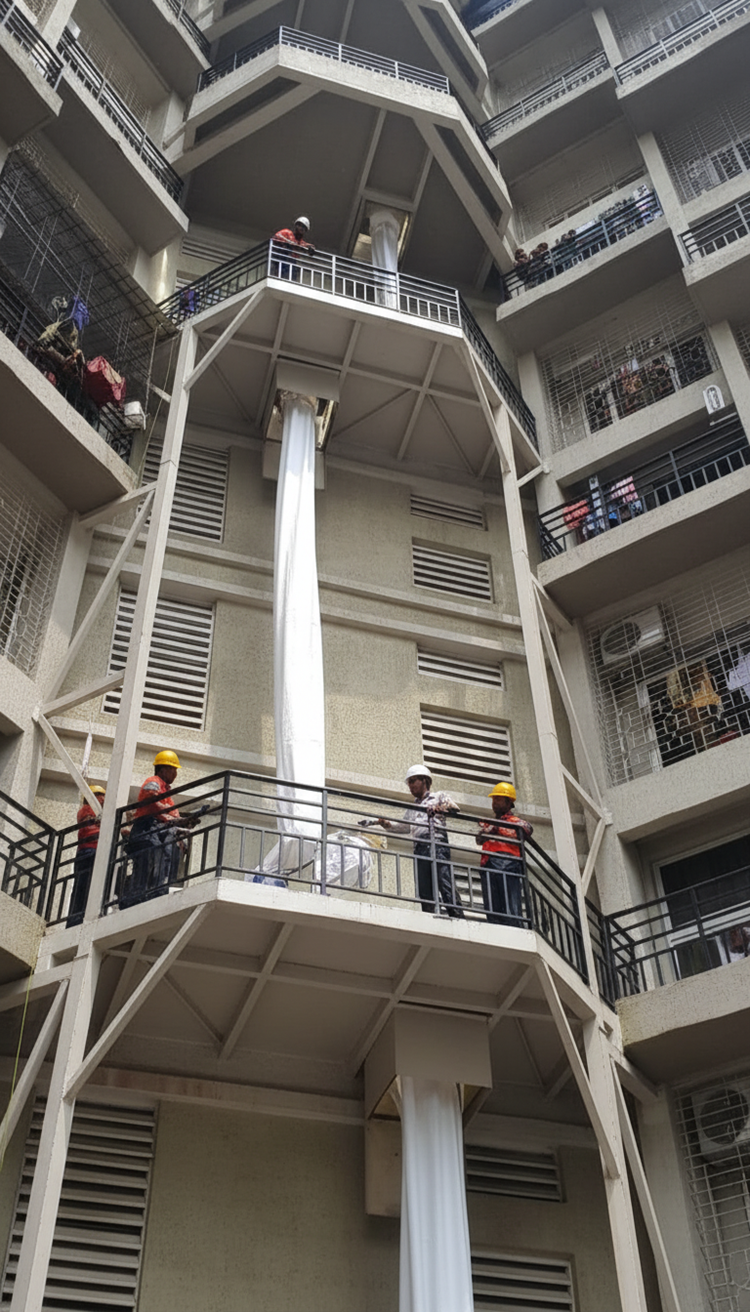
Engineered specifically as a high-volume vertical mass-evacuation layout for medium to high-rise skyscrapers, shopping malls, and large commercial centers. This system is permanently installed inside a protected vertical shaft, allowing occupants from completely different floors to enter the same vertical chute framework simultaneously during fires or unexpected disasters. The system is deployed in segments at each floor level along the same vertical line, allowing hundreds of people to escape in an incredibly short time. Its dual-layer technical fabric construction features an outer speed-restraining module to enforce controlled speeds, while the heavy-duty inner layer safely handles the total loaded structural weight.
- ✓ Shaft Dimension Rules: Requires separate concrete duct layout planned during early architecture designs.
- ✓ Sizing Configurations: Requires compact 4ft x 4ft shaft for up to 10 stories, and extended 4ft x 8ft shaft sizing configuration for skyscrapers.
3. Sloping Escape Chute
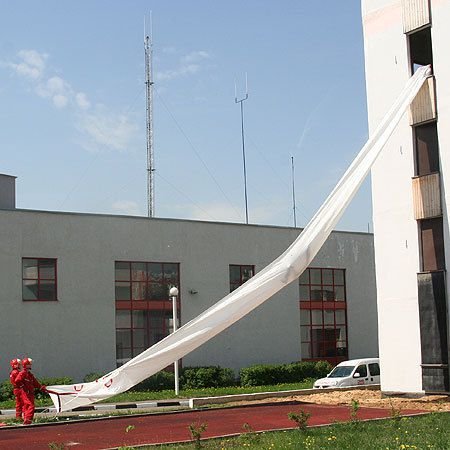
The sloping stationary escape chute is custom-tailored for multi-story industrial plants, chemical refineries, and manufacturing complexes where a direct vertical dropdown line is entirely restricted by underlying pipelines, machinery decks, or architectural constraints. Deployed at a calculated 45-degree slant, it smoothly glides occupants down an inclined technical fabric path away from structural hazard zones directly to a safe perimeter line. This system is highly recommended to assist blind individuals or people with physical disabilities, and requires a trained ground-level coordinator to anchor the base landing frame prior to operation.
| Elevation Level / Layout Parameters | 2F | 3F | 4F | 5F | 6F | 7F | 8F | 9F | 10F | 11F | 12F | 13F | 14F | 15F |
|---|---|---|---|---|---|---|---|---|---|---|---|---|---|---|
| Building Height (mtr) | 6M | 9M | 12M | 15M | 18M | 21M | 24M | 27M | 30M | 33M | 36M | 39M | 42M | 45M |
| Chute Length (mtr) | 8.5M | 12.8M | 17M | 21.2M | 25.5M | 29.7M | 33.9M | 38.2M | 42.5M | 46.7M | 51M | 55.2M | 59.4M | 63.6M |
4. Mobile / Portable Fire Escape Chute
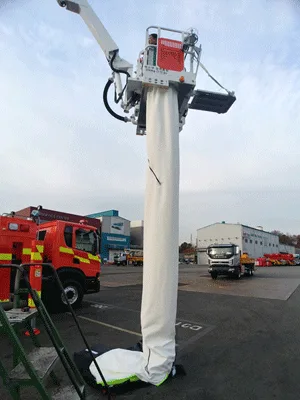
Developed specifically as standard critical high-rise rescue equipment for government and private Fire Rescue Departments worldwide. Traditional fire truck aerial ladders and snorkel buckets carry a strict load limitation of only 3 to 4 persons at a time, demanding slow, repetitive up-and-down trips during big high-rise fires. By attaching this portable high-strength chute directly to the side rigging of the platform cage or hydraulic ladder, response teams can evacuate hundreds of trapped people continuously in a single trip. Evacuees glide down safely through the fabric column while the snorkel cage remains locked in position, drastically reducing risk exposure for firemen and saving precious lives.
5. Mining Vehicle Escape Chute
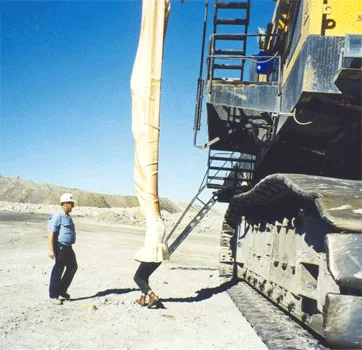
A heavy-duty, highly specialized personal survival chute built exclusively for operators of massive open-cast excavators, dumpers, heavy draglines, and earthmoving machinery. If a sudden catastrophic engine bay flash explosion or hydraulic fluid fire erupts, the operator's primary metal ladder cabin exit often becomes completely blocked by toxic smoke and flame lines. Positioned directly adjacent to the control cabin deck, our vertical escape chute triggers an immediate, insulated dropdown path straight to the ground. The system is engineered to handle massive continuous chassis vibration and heavy ambient mineral dust loading without sacrificing structural deployment reliability.
Where Are Fire Escape Chutes Commonly Used?
Emergency escape chute systems protect civilian scores across high-occupancy structures, critical platforms, and processing zones.
Residential & Homes
Residential Buildings: Fire escape chutes are widely used in apartments, housing societies, villas, and builder floors where staircases may become unsafe during emergencies. In residential settings, including apartments and individual homes, fire escape slides for homes or fire escape slide for home use may be considered where upper-floor evacuation poses safety challenges.
Commercial Buildings
Deploys as secondary commercial building safety solutions within high-rise corporate office blocks, hotels, resorts, schools, multi-storey complexes, and Indian hospitals to satisfy high-occupancy evacuation designs.
Industrial Facilities
Engineered securely to support elevated processing decks, warehouses, processing plants, factories, and infrastructure sites where vertical hazard zones demand fast unpowered rescue devices.
The Pioneers of Fire Escape Chutes in India
We hold the ultimate engineering legacy of introducing Fire Escape Chute systems to India. Back in 2009, we completed the nation's historic first-ever high-rise installation at the 48-story Planet Godrej building in Mumbai. Our ground-breaking work was highlighted nationally by Star News, showcasing our leadership team demonstrating controlled descent procedures.
Because of our deep engineering expertise since 2008, we were officially invited by the Mumbai Municipal Corporation (MCGM) and the High-Rise Committee to provide technical inputs for framing safety regulations. Today, our setups strictly satisfy international certifications and urban DCPR-2034 statutes.
Fire Escape Chute Price in India — Honest Cost Breakdown
Explore our commercial parameters mapping out single entry packages, multi-entry vertical spiral fire escape chute structures, and portable fire escape solutions.
| Escape Chute Type / Configuration | Price Range Metrics | Best For / Structural Sizing Target |
|---|---|---|
| Internal / External Emergency Escape Chute (Single Entry) | ₹12,999 – ₹49,999 per meter | Apartments, Residential Towers, Builder Floors, Office Balconies (2F onwards) |
| Multi Entry Spiral Escape Chute System (High-Rise Type) | Custom Project Quote | Skyscrapers, Shopping Malls, Commercial Centers with 10+ Floors Concrete Shafts |
| Portable / Mobile Escape Chute System Pack | Starting ₹15,999 per meter | Municipal Fire Departments, Snorkel Platforms, Hydraulic Aerial Rescue Cages |
Fire Safety Standards and Evacuation Planning Regulations
In India, structural building fire safety norms and emergency evacuation plan for high-rise buildings guidelines are governed under the statutory directives of the National Building Code of India (NBC 2016). The NBC dictates that high-rise residential buildings and towers must integrate adequate means of escape, including staircase corridors, fire exits and auxiliary evacuation tools. Globally, these emergency evacuation systems are widely recognized as a critical component of fire safety planning in multi-storey buildings.
Emergency evacuation devices like high-rise emergency escape system chutes serve as vital supplementary tools when fire tracks block primary stairwells. For specialized manufacturing decks, remote crane operations, or wind turbines, check out our technical compliance sheets for alternative setups like the Self-Rescue Device or our heavy-duty Air Safety Cushion grids. For direct queries regarding installation guidelines, submit your blueprints to our technical support team via the specialized Contact Portal.
- Strict structural alignment with national disaster management safety criteria.
- Full integration compatibility with urban high-rise building bylaws and DCPR-2034 statutes.
- Satisfies fire safety requirements for high-rise buildings and fire safety norms for schools in india.
Global & Pan-India Supplier Presence Grid
Our certified vertical escape chute installations clear rigorous government safety audits, compliance checks, and structural fire safety norms for schools in gujarat and other institutional layouts.
Sweden • Jordan • Thailand • Bangladesh • Global Markets
Delhi NCR • Gurugram • Noida • Ghaziabad • Faridabad • Chandigarh • Mohali • Zirakpur • Karnal. Providing certified fire safety solutions in Haryana and fire safety products in Panchkula.
Mumbai (Top fire chute vendors in mumbai) • Thane • Powai • Nashik • Ahmedabad • Kolkata • Joda (Odisha) • Noamundi (Jharkhand) • Raipur • Indore • Bengaluru • Chennai • Hosur (Tamil Nadu).
Core Technical Features of the Escape Chute System
Our unpowered vertical escape chutes permit rapid, mass evacuation from high rise structures during life threatening emergencies.
No external power source or battery grid backup is required for runtime operations.
Multi-layer insulated fabrics protect evacuees completely from direct ambient fire effects.
Requires little or zero instruction for deployment; usage is simple and intuitive.
Allows a continuous, high-volume vertical flow of evacuees down single lines simultaneously.
Always accessible, quick to deploy during structural fire, earthquake, or terror crises.
Demands minimal physical exertion during descent; gravity executes the dropdown sequence.
Users retain full personal physical control over the speed parameters of their own descent.
Allows external tracking operators to regulate descent velocities using ground anchoring lines.
Suitable for all age groups and physical mobilities, including physically impaired and injured casualties.
International Certifications & Quality Standards
Every fire escape chute we supply is manufactured and tested to the highest global safety standards. We are proud to be one of the very few companies in India carrying this full range of international certifications.
| Global Safety Certification Code | Technical Quality Protection Domain & Scope Covered |
|---|---|
| ISO 9001:2015 / 14001:2015 | Global benchmarks certifying premium institutional Quality and Environmental Management Systems. |
| DIN 14151-3 | The core specialized European structural standard regulating testing metrics explicitly for Escape Chute Modules. |
| EN ISO 6941 / BS 5438 | Strict dynamic flame spread tracking and structural flammability checks for engineering textile fabrics. |
| DIN 4102 B1 / NFPA 701 | Global fire behavior classifications validating self-extinguishing and non-combustible material integrity. |
| DIN EN 20811 / ISO 13938-1 | Hydrostatic water penetration resistance paired with optimal bursting strength thresholds under extreme loading. |
Frequently Asked Safety Questions (FAQs)
Get immediate, certified engineering answers regarding the operations and loading metrics of fire escape chutes.